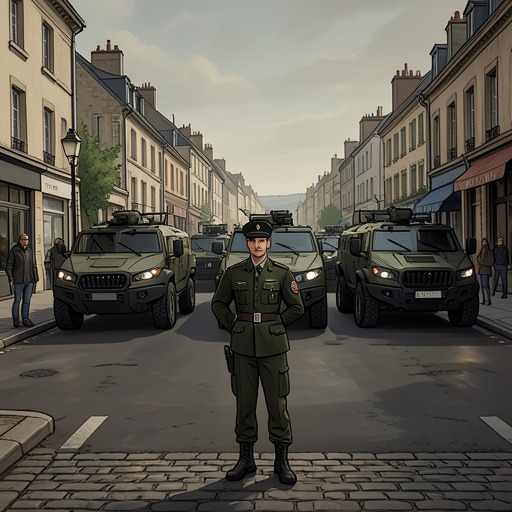
French Army
Promise at DawnThe French Army is a recurring object of faith, criticism, and retrospective reassessment in Romain Gary’s memoir. He first imagines its senior command as capable of turning German advances into a trap; in 1940, while serving as a pilot, he carries out patrols under a misleading account of the political situation. The distance between his trust in the military establishment and his later recognition of its failures gives the institution its significance in the narrative.
Command, Tradition, and an Imagined Commander
Gary’s picture of the French Army is shaped by confidence in its capacity for initiative. In a remembered conversation at an airfield, his mother proposes an immediate offensive and a march on Berlin. Gary later imagines that, if Charles de Gaulle had not been available, she would have made a better commander of the French armies than the existing leadership. He argues that she possessed both an instinct for the offensive and an ability to animate people who lacked energy, and contrasts this imagined leadership with a force left inactive behind the Maginot Line with its left flank exposed.
That counterfactual is also a measure of Gary’s distrust of the actual command structure. He recalls German armor breaking through at Sedan, but describes how, at the time, he had interpreted the advance as part of a French General Staff plan. His certainty that France would recover at the last moment turned the German success into what he mistakenly imagined was evidence of French strategic control. The episode shows how patriotic confidence could shape his reading of military events before he had reason to question it.
Patrols at Bordeaux and a False Briefing
On June 13, 1940, after returning from a bombing mission, Gary landed at Tours to refuel and was wounded in the leg during an air raid. At Bordeaux-Mérignac Airfield, he and two other crews were then assigned low-altitude patrols over working-class districts. The briefing presented the patrols as protection for Philippe Pétain, supposedly determined to continue fighting both Germany and a Communist fifth column preparing to seize power and make terms with Hitler.
Gary accepted the explanation. Flying over Bordeaux with his machine guns loaded, he was prepared to drop bombs or fire on a suspect crowd at a signal from base. He later understood that the supposed internal threat had concealed the real political danger: in his account, the true fifth column had already prevailed by weakening the country’s will from within. He also stresses that the deception may have originated with well-meaning colonels at Mérignac rather than with orders from the highest levels. The episode presents military obedience not as an abstract virtue but as an action made dangerous by false information.
Pétain, Military Reverence, and Disillusionment
Gary’s readiness to obey was reinforced by his reverence for Philippe Pétain. He had been taught to regard the marshal as the embodiment of military virtue, and recalls his mother speaking his name with religious respect. That inherited faith made it difficult for Gary to imagine Pétain as a defeatist whose personal animosities and political passions could take precedence over the country’s interests.
Gary connects this failure of judgment to the way he had previously interpreted the Dreyfus Affair: he had preserved his faith in military leaders by treating the scandal as an attack on a naturalized Frenchman and on a Jew, rather than as evidence that the military establishment could act unjustly. His retrospective account thus implicates not only commanders but also the habits of loyalty through which he excused them. The French Army matters here as both a real authority and an ideal Gary had been taught not to doubt.
Defeat and the Limits of Obedience
After the defeat and armistice of 1940, Gary says that he bears no resentment toward those responsible and understands those who refused to follow Charles de Gaulle. His explanation is severe: people settled into prudent acceptance of what they called the human condition and treated Hitler’s victory as inevitable. In his view, such caution may have been rational, but its logic would also have prevented the acts of risk and creation on which resistance, art, and civilization depend.
The memoir therefore does not reduce the French Army’s failure to a single officer or decision. It sets Gary’s earlier, almost instinctive trust in France and its military traditions against the collapse of 1940, then asks what that trust had made him unable to see. His mother’s uncompromising, idealized France supplies the counterpoint: not a realistic account of military power, but a demand that defeat and political calculation should not be mistaken for the only possible course.